
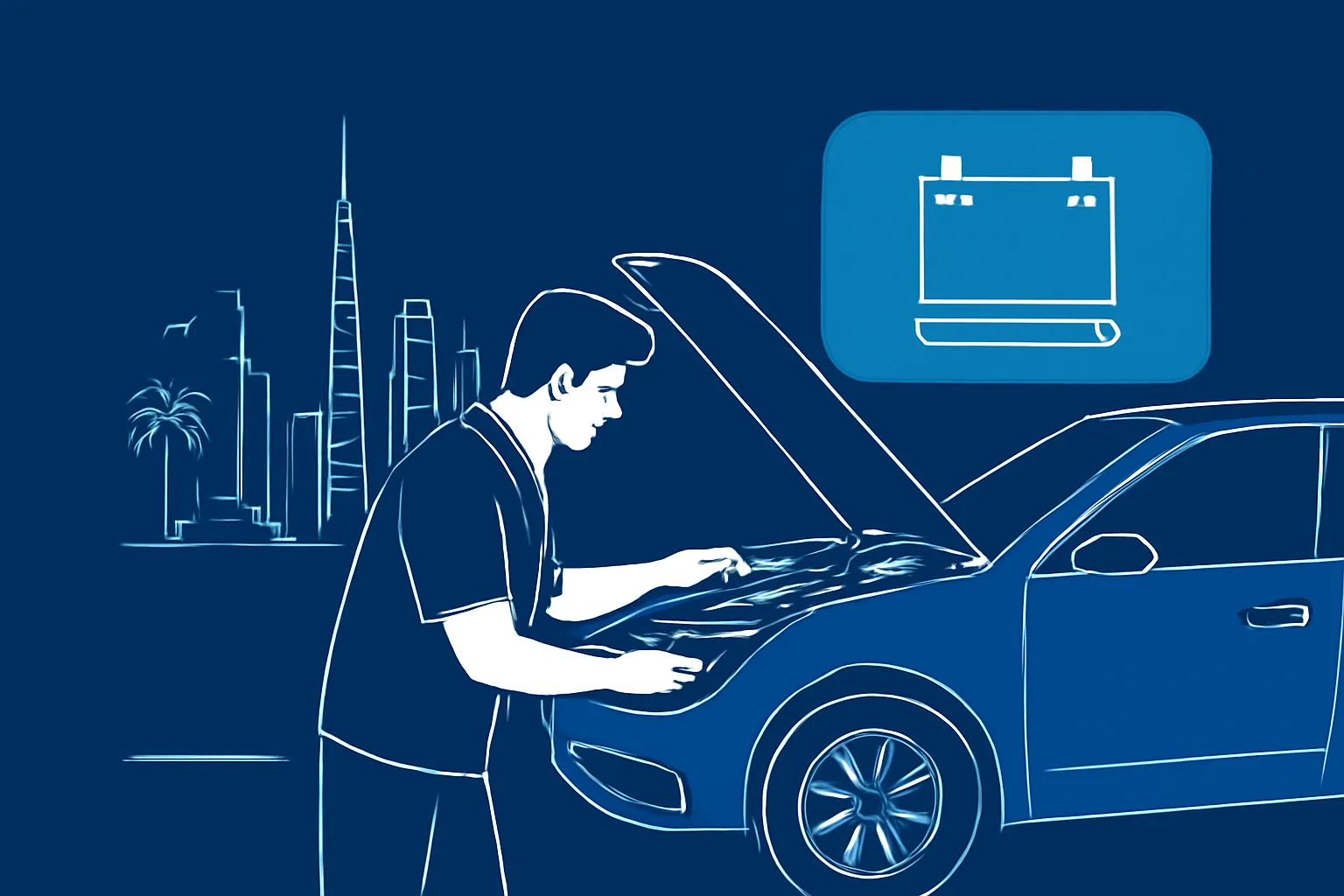
A car that will not start usually points first to the battery or starting circuit, but the sound and dashboard response determine the next check, the safe repair choice and whether you need a garage immediately.
How do I tell why my car will not start?
The first decision is whether the engine turns over or stays silent, because those two symptoms lead to different repair paths. Turn the key or press the start button once and listen. A rapid clicking sound, one heavy click or complete silence usually points to the battery, battery connections, starter circuit or immobiliser. A normal cranking sound with no ignition points more towards fuel delivery, ignition, engine management or a key-related fault.
Check the dashboard before trying again. Dim lights, flickering displays or a reset clock support a low-voltage problem. Bright lights do not rule out a weak battery, because the starter needs far more current than the accessories. A warning about the key, steering lock or immobiliser changes the next step.
Do not keep repeating the start attempt. Repeated cranking can flatten the battery, overheat the starter or add fuel to an already flooded engine. Write down exactly what happened, including sounds, warning messages, recent servicing and whether the car stopped while driving. That short description is more useful to a garage than saying only that the car is dead.
For more context, read How To Get Fair Car Repair Quotes In Dubai Before Booking.
Working through the same job from the other side? Best Car Repair Garages in the UAE: A Buyer’s Guide — The best UAE garage is the one that proves its diagnosis, quote and warranty. Use eight checks to compare trust, capability and final cost.
What should I check first before calling a garage?
Check the obvious, low-risk causes first: the gear selector, key, fuel level, visible battery terminals and dashboard messages. An automatic car normally needs to be in Park or Neutral, while a manual car needs the clutch fully depressed. Try the spare key if the first key is not recognised, but do not force a key into the ignition or repeatedly press a reluctant start button.
Look for loose or badly corroded battery connections without touching exposed wiring. Do not open electrical control units, bridge terminals or attempt a jump-start unless you have the correct equipment and know the vehicle procedure. Modern cars can be damaged by an incorrect jump connection, and hybrid or electric vehicles need their own safety instructions.
A fuel gauge is not proof that usable fuel is present, especially if the car is parked on a slope or the gauge has a fault. If the vehicle is in a dangerous position, move people away from traffic and call roadside assistance rather than troubleshooting beside the road. Photograph the dashboard and note the car's location, model and timing before arranging help.
For more context, read Brake Repair Cost in the UAE: Get a Fair Quote.
Which causes are most likely when the engine does not crank?
A low or failed battery is the most common first suspect when the engine does not crank, followed by poor battery connections, a starter motor fault, a charging-system problem or a key and immobiliser issue. The order is a troubleshooting sequence, not a diagnosis. A new battery will not solve a failed starter, and a jump-start that works may only hide an alternator fault.
A single click can come from a starter solenoid or a battery that cannot deliver enough current. Rapid clicks commonly indicate voltage dropping under load. Silence can involve the battery, ignition switch, gear-position sensor, fuse, relay or security system. The same symptom can therefore produce very different repair bills.
Ask the technician to test the battery under load, inspect the terminals, check charging output and confirm the starter circuit before approving replacement parts. Ask for the test result and the failed component in writing. A workshop that recommends several parts without explaining which test failed has not yet given you a useful repair decision. The final price remains an estimated or typical comparison only until the garage inspects the vehicle.
What if the engine cranks normally but will not start?
A normally cranking engine that will not start usually needs a different diagnosis from a flat battery. Likely areas include fuel supply, ignition, engine-speed sensing, the immobiliser, air intake or electronic engine control. A nearly empty tank, failed fuel pump, faulty crankshaft sensor and missing spark can feel identical from the driver's seat.
Check whether a key or security warning is displayed and whether the fuel gauge is credible. Avoid spraying unapproved starting products into the intake, disconnecting sensors or repeatedly pressing the accelerator. Those actions can damage components or obscure the original fault. Hybrid and electric vehicles should be handled under the manufacturer's procedure rather than treated like a petrol car.
A garage should establish whether the engine has the required fuel, spark and timing signals before replacing injectors, pumps or sensors. Ask whether diagnostic codes are present, whether the code identifies a cause or only a symptom, and what test confirms the proposed repair. If the car stopped suddenly while moving, treat the fault as urgent even if it later starts again. Intermittent starting faults can leave you stranded in a less safe place.
When should I stop trying and get professional help?
Call professional help immediately if you smell fuel, see smoke, notice burning insulation, find a leaking fluid, hear severe mechanical knocking or cannot move the car safely away from traffic. Do not keep starting a car with a suspected fuel leak or overheated wiring. Switch it off, leave the vehicle if necessary and contact roadside assistance or emergency services according to the danger.
A tow or mobile technician is also the sensible choice when the car is in a basement, on a busy road, blocking a junction, parked where jump-starting is unsafe or fitted with a high-voltage system you cannot identify. A car that starts only after repeated attempts, stalls again or loses electrical power while driving should not be treated as fixed.
For a quiet failure in a safe location, you can arrange a diagnostic visit or recovery to a suitable garage. Tell the provider whether the engine cranks, whether the dashboard works and whether the fault is intermittent. Those details help send a garage equipped for the likely job rather than simply the nearest available workshop.
Which repair option suits a no-start fault?
A mobile diagnostic visit suits a safe, accessible car when the likely issue is electrical, battery-related or a simple starting-circuit fault. A tow to a workshop is better when the engine cranks without starting, the cause is unclear, the car is in a risky location or testing needs equipment that cannot be carried roadside. The cheapest first action is not always the cheapest complete repair.
Ask what the call-out covers, whether diagnosis is charged separately, whether recovery is included and whether parts are fitted only after approval. Ask the garage to separate inspection, labour, parts, towing and any additional testing. A typical or estimated AED range is useful for comparison only when it states what is included, the vehicle type or job basis, and the date. The garage sets the final price after inspection.
GarageFinderUAE is a quote request and comparison service for UAE car owners. You describe the car, fault, area and timing once, and the enquiry is prepared for garages that handle that job so you can compare quotes before approving work. GarageFinderUAE is not a garage or review site, and it does not publish rankings.
How can I compare a fair UAE repair quote?
Compare the diagnosis and scope before comparing the AED total. A fair quote should identify the suspected failed system, the tests already completed, the proposed repair, parts and labour, recovery or call-out charges, applicable tax, and what remains uncertain. A low figure that excludes diagnosis, towing or programming may not be cheaper than a higher, complete option.
Ask whether the replacement part is new, manufacturer-approved, aftermarket or used, and whether coding or calibration is needed after installation. Confirm whether the car will be tested after repair and what happens if the proposed part does not solve the fault. Do not approve a chain of speculative replacements merely because the car is stranded.
GarageFinderUAE publishes typical comparison ranges dated on the page, never a quote. Use any range as a starting point only, then ask the selected garage to confirm the final price after inspection. Compare at least the explanation, inclusions and next diagnostic step, not just the headline number. Keep written approval and the original fault description so a changed scope can be challenged promptly.
Should I repair the car now or arrange a temporary fix?
Repair the car before normal driving when the fault involves fuel, steering, braking, charging, overheating, wiring or an engine that stalls. A jump-start or reset is a temporary way to move a vehicle to safety, not proof that the underlying problem has gone. If the car starts after assistance, ask why it failed and whether the charging system has been tested.
A temporary solution may be reasonable only when a professional confirms that the car is safe to move for diagnosis and tells you how far and under what conditions. Do not drive at night, through heavy traffic or over a long distance simply because the engine restarted. Recovery may cost less than a second breakdown or damage caused by continuing to drive.
Before handing over the keys, record the mileage, fuel level, warning lights, visible damage and contents. Remove personal items and keep both keys if they are not needed. Give written permission for diagnosis only if you are not ready to approve repairs. The best decision is the one based on a confirmed fault, a stated scope and a final price from the garage, rather than urgency alone.
Read next: What UAE Drivers Compare Before Choosing a Car Repairer — Compare eight checks for UAE car repair services, including diagnosis, parts, warranty, workshop evidence, timing and the final AED quote. For what the job should cost before you ask anyone for a price, see Major & minor service.
