
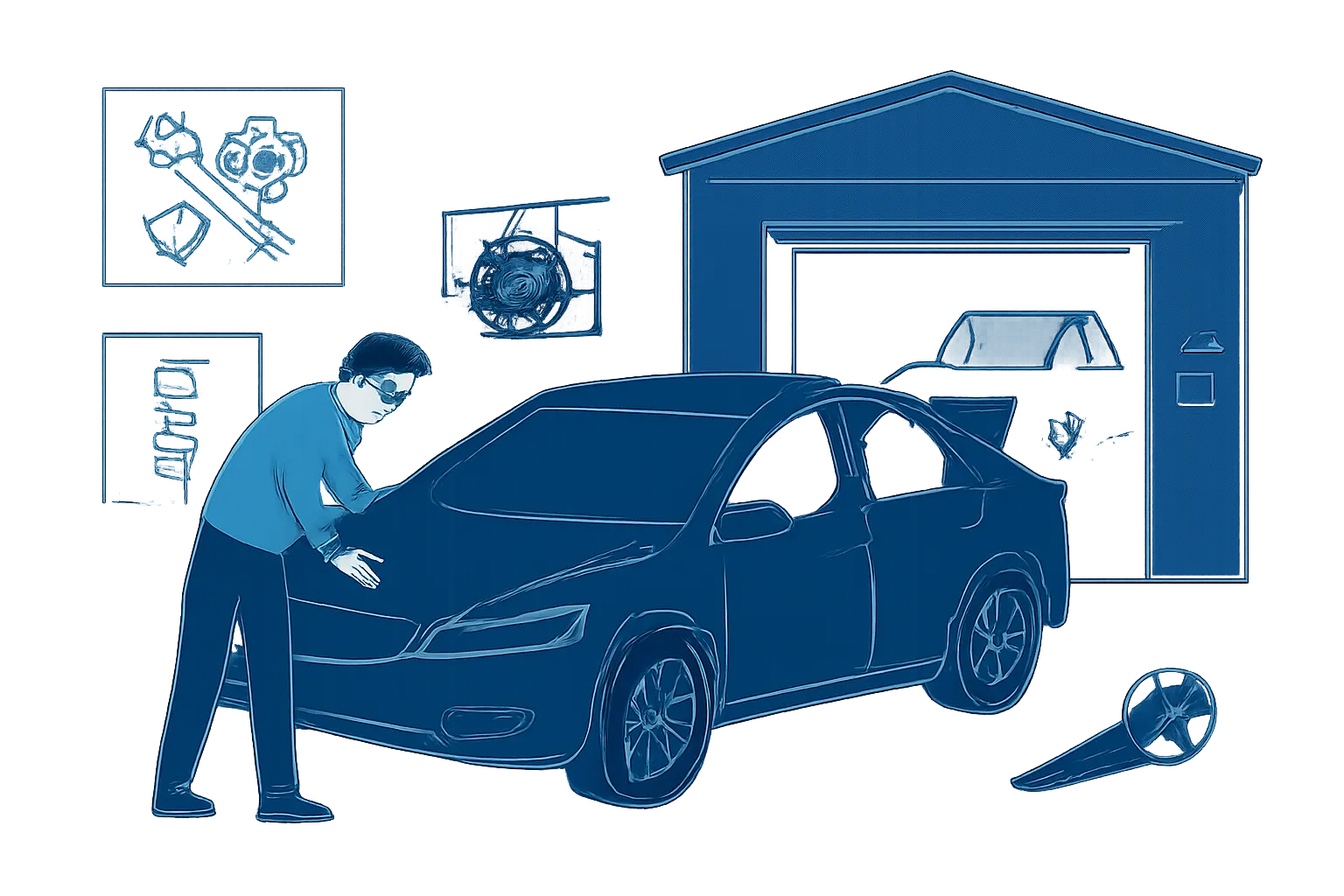
Before accepting your car, compare the completed work with the job card, inspect the exterior and engine bay, test the controls and drive it far enough to expose unfinished work.
What should you check against the approved job?
Start with the approved job card, not the garage attendant’s summary. Use eight checks in order: agreed work, exterior, engine bay, wheels, controls, warning lights, road behaviour and paperwork. Mark each repair as completed, partly completed or not demonstrated before you accept the car.
Read the description of the fault, the parts or systems named, and any promised test. A phrase such as “check noise” is not the same as “replace front brake pads”, so ask what result the garage was meant to deliver. Photograph the mileage, fuel level and visible condition before leaving the handover area.
GarageFinderUAE is a quote request and comparison service for UAE car owners, not a garage or review site. A driver describes the car, fault, area and timing once, then the enquiry is prepared for garages that handle the job so quotes can be compared before work is approved. That comparison is useful before repair, but the job card remains the reference when you inspect workmanship.
Do not let a clean wash or a confident handover replace evidence that the agreed work was completed.
For more context, read Al Ain Wheels Tyers And All Car Auto Repair Shops 24 Hours Mussafah Sanaiya.
Working through the same job from the other side? How to Protect Your Car Before Leaving It at a Garage — Protect your car at a UAE garage with an ordered handover checklist covering photos, keys, approvals, records and collection checks.
Are the repaired panels, paint and trim properly finished?
Inspect the repaired area in daylight before driving away, because uneven paint, loose trim and new scratches are easiest to identify while the car is stationary. Walk around the whole vehicle, then compare the repaired panel with the adjacent panel from several angles.
Look for colour mismatch, rough overspray, paint runs, dull patches, sanding marks, uneven panel gaps and fasteners that appear missing. Check that bumpers, grilles, lamps, badges, sensors and wheel-arch liners sit securely. Open and close every door, bonnet and boot that was near the repair. They should latch without unusual force or contact.
Use your phone to record close photographs of anything questionable. Do not rub a suspected paint defect or remove tape, sealant or protective film yourself. Ask the technician to show what has been finished and what remains to cure, if any material needs curing time.
A fresh wash can hide dust and small marks, while bright workshop lighting can hide colour differences. If possible, move the car into natural light. Record defects before accepting the vehicle, because proving when a mark appeared becomes harder after you leave.
For more context, read Car Repair Estimate Vs Final Bill In The Uae What To Do.
How do you check the engine bay without guessing?
Check that the engine bay is dry, complete and free from fresh leaks, loose caps or disturbed wiring before collecting the car. A clean bay is not proof of good workmanship, so look for signs connected to the repair rather than judging appearance alone.
With the engine off, inspect fluid reservoirs, filler caps, dipsticks and visible hoses. Caps should be fitted, wiring should be clipped away from hot or moving components, and tools or rags should not remain in the bay. Look underneath the front and rear of the car for fresh drops or wet patches after the engine has run. Do not touch hot components or open a pressurised cooling system.
Ask what was removed, drained, replaced or topped up, and request the final fluid levels where that matters to the job. If the repair involved cooling, air conditioning, belts, battery work or an oil service, ask the technician to identify the relevant components rather than accepting a vague assurance.
A small stain may be old, cleaning water or a current leak, so ask the garage to explain it and document the answer. Rules and workshop obligations can change, so check current UAE consumer guidance if the garage will not explain a visible defect.
Do the wheels, tyres and underbody show safe workmanship?
Check the wheels, tyres and visible underbody before collection if the repair involved braking, suspension, steering, exhaust components or work near a wheel. These areas can look finished while a loose fastener, trapped hose or damaged cover remains out of sight.
Look for wheel damage, missing caps, loose plastic liners, hanging undertrays and cables or hoses that could contact a tyre. Confirm that the tyres are fitted in the intended direction where directional markings exist, and compare the visible condition with the photographs taken at drop-off. Ask whether wheel fasteners were tightened to the manufacturer’s specification and whether a torque check was carried out after wheel removal.
Do not crawl under a vehicle supported only by a jack. Ask the garage to raise the car safely if you need to see underneath, or request photographs from the technician. Check that the steering wheel is reasonably centred and that the car does not pull during the road test, but treat those observations as clues rather than a substitute for a proper inspection.
If a brake, steering or suspension fault remains, do not accept a reassuring explanation based only on a short parking-area drive. Ask what test was performed and what result was recorded.
Do all controls, lights and warning messages work?
Test every control linked to the repair, then scan the dashboard for warning lights and messages before accepting the car. Start with the ignition switched on and note which warning lamps illuminate for the self-check, then confirm that relevant lamps go out after the engine starts.
Test headlights, brake lights, indicators, hazard lights, wipers, washers, horn, air conditioning, windows, mirrors, central locking and the infotainment system if the garage worked near them. Check the reverse camera and parking sensors where fitted. Confirm that the airbag, ABS, engine, battery and tyre-pressure warnings are not newly present. A warning that disappears after restarting still needs an explanation if it was not present before the repair.
Ask whether any diagnostic codes remain, whether a system was reset, and whether a calibration or relearning procedure was required. Request the scan result or a written note of the test when it relates directly to the job. Avoid clearing codes yourself before the garage has investigated them.
A dashboard with no warning light does not prove that a mechanical fault is fixed. Pair the electronic check with the road test and the job card, and note the exact wording of any message before leaving.
How do you use a short road test to find unfinished work?
Use a controlled road test to check whether the original symptom has changed and whether the repair introduced a new one. Ask the garage to drive first if the fault is safety-related, then drive yourself on a familiar route with safe traffic conditions and no unnecessary hard acceleration.
Listen for rattles, grinding, tapping, wind noise and clicks while braking, steering, accelerating and travelling over a gentle uneven surface. Check whether the car tracks straight, the steering returns normally, the brakes feel even and the gearbox selects smoothly where relevant. Watch the temperature gauge and warning messages throughout the drive.
Do not try to recreate a dangerous fault at speed or in heavy traffic. A short handover drive may not reproduce an intermittent problem, so ask the garage what conditions were tested and whether the original fault could require more observation. Record the road speed, engine temperature and circumstances if a noise or warning returns.
Stop the test if the vehicle feels unsafe, pulls sharply, overheats, loses braking performance or shows a serious warning. Tell the garage immediately and do not continue driving simply because the repair invoice is ready. A successful handover requires a reasonable test result, not just movement from the workshop to the road.
Does the paperwork prove what was actually completed?
Before payment or collection, make sure the final paperwork identifies the work completed, parts fitted, tests performed and amount due. The invoice should be clear enough for another garage to understand what happened without relying on memory or an informal message.
Compare the invoice with the approved quote and job card. Check the vehicle details, mileage, dates, labour description, parts description, taxes or other charges, warranty terms and any diagnostic or inspection fee already discussed. Ask for the make or part reference where it affects compatibility, but do not assume a branded part is automatically better for your car.
Request the old parts if you want them and if local handling rules allow it. Ask whether any removed component was exchanged, returned or disposed of. Keep photographs, messages, approval records, the invoice and any test report together. If the garage says a further issue was found, ask for its evidence and a separate approval rather than treating it as part of the original job.
GarageFinderUAE publishes typical AED ranges for comparison, dated on the relevant page, not quotes. The garage sets the final price after inspection, so use the approved garage paperwork, rather than a website range, to verify what you owe and what was delivered.
Should you accept the car or leave the handover open?
Accept the car only when the agreed work is demonstrated, safety concerns are resolved and every remaining issue is written down with an owner and next action. A clean invoice or a request to pay does not answer an unresolved workmanship question.
If a non-safety defect remains, ask the garage to record it on the handover document and state whether it will be corrected, monitored or excluded from the job. If a safety defect, active leak, serious warning light or abnormal braking remains, do not drive away until the garage explains the risk and gives you a safe plan. Ask for a written estimate for any additional work before approving it.
Read the final document before signing. Cross out blank sections, note missing items and photograph the mileage and vehicle condition. Keep copies of all communication. UAE consumer rules and procedures can change, so check current guidance from the relevant authority if the garage refuses to document the dispute or pressures you to accept an unsafe vehicle.
GarageFinderUAE helps drivers compare quotes before work is approved, but it does not rank garages, inspect vehicles or decide whether workmanship passes. The final acceptance decision belongs to you, based on the evidence recorded at handover.
Read next: Oil Change Offers Near Me in the UAE: Check the Real Cost — Typical estimated oil and filter offers are AED 150 to AED 350. Check what is included, oil grade, location, expiry and final workshop price. For what the job should cost before you ask anyone for a price, see Major & minor service.
